Sunday, 16 August 2015

Electric power in the Whitsundays

I was lucky enough to have a ride in a visiting new Telsa MS85 around Airlie Beach and Cannonvale in the Whitsundays. Thanks to Marc Talloen and his enthusiasm for electric powered vehicles, I too am now hooked. Not that we can afford this model car - we'll have to wait for the cheaper version to be released in Australia in a few years time - but it certainly looked great parked in our driveway!


Tesla Motors is an American automotive and energy storage company that designs, manufactures, and sells electric cars, electric vehicle powertrain components, and battery products. They are taking the world by storm - well the U.S and Europe at least - and are starting to make a presence here in Australia.

The electric vehicle will be a perfect complement to the solar farm we have on our house roof. It will cost us nothing but the power from the sun to charge, or a minimal amount if charging from the grid. There is very little maintenance required on electric vehicles, and best of all they produce no emissions. Here is the car of the very near future!

Charging at the local sports ground with 3-phase power


Sunday, 9 August 2015

Art Whitsunday Exhibition

The 28th Annual Art Whitsunday Exhibition was on last weekend at the Whitsunday Arts and Cultural Centre (WACC), coinciding with the Whitsunday Reef Festival.

Judged by Chris Saines, Director of GOMA (Gallery of Modern Art) in Queensland's state capital of Brisbane, he had his work cut out for him determining a winner for each of the 12 categories, which included the theme climate change.

The WACC is a spacious and newly renovated venue; perfect for an exhibition. Well done to all the entrants. I am inspired to get creative myself!

The inaugural Whitsundays annual regional art show is coming up in October. Unlike the Art Whitsunday exhibition, anyone can enter, so it's time to whip out the paintbrushes and paint pots.

These would look good in our garden - company for the chickens too!
28th annual art exhibition

Art friends
My favourite medium - watercolour
Belinda Curry's take on climate change
Textiles
Wendy Eriksson's infamous boats and fish
People's choice - and the only one sold!

Sunday, 2 August 2015

Shark Bay revisted

Flicking through the July issue of The Wanderer, I came across a very familiar motor home. "That's Delvy!", I announced proudly, "and that's my photo!".

Disappointed I didn't make Campervan & Motorhome Club of Australia calendar again this year, I was pretty happy my photo, unexpectedly, still got into print. Although, using it to advertise insurance wouldn't have been my first choice. But, hey, what does it matter - they gave me credit for it, and it's a great photo worth sharing. So much so that it's in the August edition too.

Advertisement in The Wanderer - July & August

The photo was taken at Shark Bay, Western Australia in June last year. I tossed and turned all night as the glow of the full moon was so bright. When colour began to emerge in the dawn sky it was time to get the camera out.

Here's what I wrote about that camp and the area the night before the photo was taken....

                                     
I am writing this on the shoreline of Henri Freycinet Harbour at Fowlers Camp in the Shark Bay World Heritage Area. The shadows are lengthening, there is just a ripple across the clear water and a lone Caspian tern is relaxing on the sand spit: sunset is not far away.

Another big day driving, but then this is big country and one has to drive a long way to see the sights. Once we turned off the North West Coastal Highway, surviving the many road trains that overtook us, and once again waving to fellow travellers (now the caravans are coming thick and fast!), it was a bit of a drive between the tourist spots. Hamelin Pools boast the best example of stromatolites in the country, with scientists visiting from all over the world to study these ancient living organisms.

A loop walk in the area takes you through a shell block quarry. Fragum Cockle shells washed with rain water cement together to form a solid structure (called coquina shell) which can be used for building blocks. They came in handy when there was no timber or stone around. Shell Beach up the road (in WA terms this means at least 50kms) lives up to its name as the cockle shells are up to ten metres thick and stretches for 120kms.

The Eagle Bluff boardwalk is a good vantage point to spot marine life in the shallows. We saw a ray of some kind as we were taking in the view of a disused guano island and the stark coastline.

Off to see the dolphins at Monkey Mia tomorrow, before we drive back out of here and head for Carnarvon.

Original photo - Full moon at dawn, Shark Bay


Sunday, 26 July 2015

Reef walk

As the tide goes out there are all sorts of creatures that can be viewed on the reef. It was a perfect Whitsunday winter's day - blue sky and no wind - for exploring the reef from Hydeaway Bay, Cape Gloucester, top of the Queensland Whitsunday islands.

Falling tide at Hydeaway Bay

On this day in July, the water was crystal clear - no rivers flow into this bay - so we could see plenty of marine animals and plants. There is a healthy population of sea cucumbers, filtering organisms from the sandy bottom.

Various green sea grasses swayed in the water amongst sea squirts, whelks and hermit crabs.


We were lucky to stop a Mantis Shrimp in its tracks with a reef bootie as it darted around. Look closely!


Sand dollars, which are flat burrowing sea urchins, are a common sight.


So too are microatolls. This is where corals growing on the reef flat encounter a barrier - the water surface at mid-tide level - above which coral tissue simply cannot survive. The presence of this barrier forms fascinating coral growth in which the colony continues to expand around its radius, but is dead on top. As the colony gets older, the dead patch may become hollowed out, and other corals may settle in the shallow lagoon so formed. These formations resemble miniature coral atolls and so are referred to as 'microatolls'.


If you are interested in an interpretative reef walk, Whitsunday Training has a permit from the Great Barrier Reef Marine Park Authority to conduct educational programs for schools and other study groups.

Sunday, 19 July 2015

The Burdekin

A trip away in the motor home, Delvy, couldn't come soon enough. I love being on the road and exploring. This excursion had a purpose though, which gave us the excuse we needed to turn the key and give Delvy a run after a few months of being parked up beside the shed. Now that we have opted for a more stationary lifestyle (for now anyway) to put some hard earned cash away, the old girl doesn't get out much. So when I was asked if I wanted to play in a three day tennis tournament in the Burdekin it was the perfect opportunity to bring along my own accommodation.

Driving north west from Proserpine in the Whitsundays on the Friday afternoon was a little hard on the eyes, as the Bruce Highway heads straight into the sun. The afternoon light was enchanting, but were glad to see the sun sink so we could see where we were going!

We pulled up at Home Hill on dark, and instead of heading for the 24 hour comfort stop adjacent to the railway line, figuring it would be pretty full anyway, we opted for the self contained park over at the showground at $6 per person.

Home Hill Showground overnight park
There are thousands of people travelling on the road in northern Queensland at this time of year: every second vehicle is a RV, and the free overnight stops are full to overflowing. But we are happy to pay a small fee to the local community to park our bus for the night. The clean amenities on offer are a bonus.

Home of the hand sugar cane cutting championships, the freshly cut burnt stalks was evidence of a recent competition. The cane is burnt prior to harvesting in the Burdekin area as it grows thicker and taller than usual, creating more trash that makes it difficult to mechanically harvest.

Hand cut sugarcane
The oval is no longer a place for recreational activities as it is now fully covered with vegetable beds.

Main arena turned vegetable garden
It was a early start in the morning as I was due at the Ayr tennis courts at 9.00am, ready to play in the 35th annual Home Hill Sugar Bowl tournament.

Crossing the Burdekin

The Burdekin River

Delvy at Ayr tennis courts
Teams of six compete in 15 sets of tennis each over three days, alternating between Ayr and Home Hill tennis clubs. I was in a ladies A2 grade team called the Double Shots with two girls from Mackay, two from Magnetic Island and one other from Proserpine. In warm and dry conditions we managed to be in second place at the end of the second day. However, the third day brought challenging windy and squally weather and we couldn't win enough games so finished a respectable fourth - a solid midfield performance. We'll be back again next year though. It was a very well run event, fun with good competition and a great way to meet some new people.


The Double Shots

It was fabulous to be back living in the motor home too, if only for a weekend. So looking forward to the next trip.

Overnight at Home Hill courts

Beside Home Hill courts which are in the middle of the race course.

Saturday, 11 July 2015

Whitsunday forest night life

Living on five acres in the Whitsundays surrounded by dry vine forest means we get to see all sorts of wildlife, particularly at night.

The endangered Proserpine Rock Wallaby is only found in this area of Australia. We often see one or two feeding on the grassy areas around the house, but the slightest noise will send them crashing off into the forest. If you want to see more than a glimpse, the trick is to just sit and wait quietly in the dark but they may or may not reveal themselves. Part of our land has a covenant to protect the wallaby's habitat so we know they are out there. Often the only time we know they have visited the yard is by the lack of foliage on my vegetable plants!

Photo: www.animalinfo.org
Bandicoots, on the other hand, love to dig small holes in the ground looking for tasty snacks such as worms, ants and termites, so it's fairly obvious they have been around. They are good aerators of the soil; we hear them more often than we see them, scratching around in the dirt outside our bedroom window.

Photo: Damon Ramsey


Another animal that hunts at night is the python. While we are yet to see a live one, we have found a few skins lying around the garden: the first one we came across was over two metres long.

Shedded skin of a python
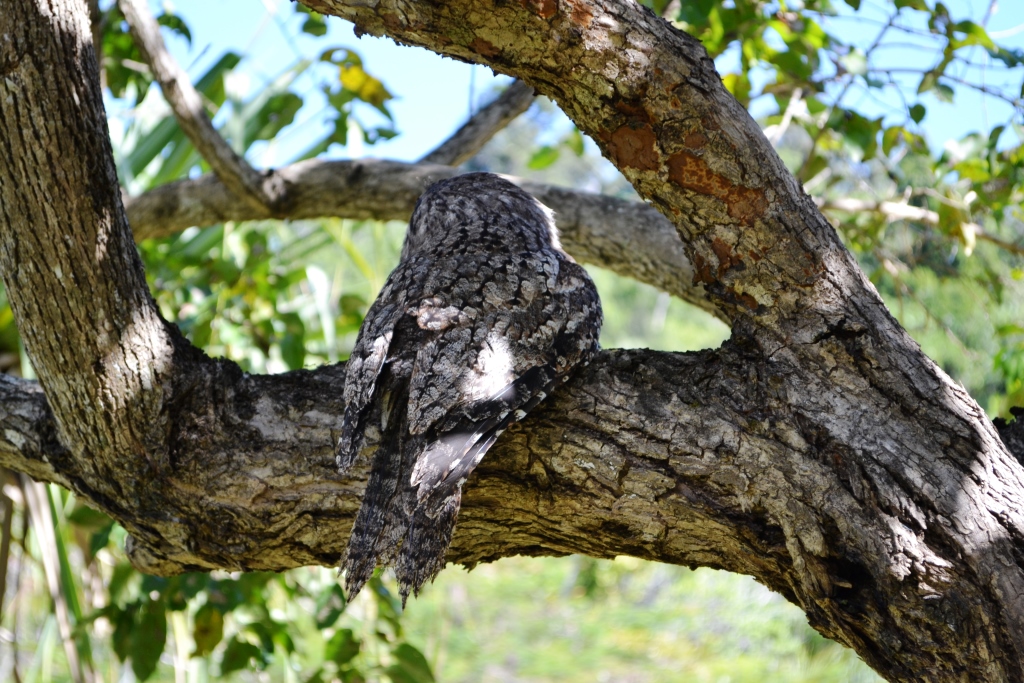
The Tawny Frogmouth, often mistaken as an owl but closely related to the nightjar, is also nocturnal and rarely seen. So it was a surprise to see one sitting on the ground at about 9 o'clock in the morning last week. We picked him up and popped him on a rock to check him over, but he was very unresponsive. We then put him on a tree branch but still he didn’t do anything. We eventually called the wildlife rescue people and they said to wait until dark to see if he'll fly off. Checking on him after dinner he still hadn't moved and was also covered in green ants. So we gently placed him in a box and drove him to the wildlife carer. He became lively and bit her on the finger, but other than that he just looked miserable. Dianne couldn’t work out what was wrong with him – he wasn’t eating, his right wing was lame and he wouldn’t fly. After a couple of days he eventually regurgitated a big snail with a barb on it, which must have been sticking into his chest making him very uncomfortable. He then became an owl again and was ready to be released. On dusk last night Dianne brought him back to our place, popped him on the tree branch, gave him a nudge and away he went into the night – flying perfectly.

The well camouflaged Tawny Frogmouth


Another creature that forages at night is the dreaded cane toad. Introduced to Queensland sugarcane crops to control the cane beetle, they are now found right across the continent with not one beetle eaten. They would have to be the most ugliest creature, but the worst thing about them is their poisonous glands are lethal to native wildlife.
Photo: www.ozanimals.com

Sunday, 5 July 2015

Whitsunday Motorsport

For grassroots motorsport, the Whitsundays is up there with the best.

Near Proserpine (Whitsunday Coast) airport, the Tonker Park Raceway & Driver Training Facility is on 25 acres of a reclaimed cattle property with a dirt and tarmac track.


The members of the Whitsunday Sporting Car Club have put a lot of work into building the dirt track (and facilities), from tight bends to open and flowing terrain, so you can test all aspects of your vehicle: braking, acceleration and handling. This is the cheapest form of motorsport available as you can compete in any car. You just have to become a club member, organise a CAMS licence, pay the entry fee and away you go. Gary was taken for a spin in an old Corolla, and I went in a Hyundai. Lap time was about 1 minute 40 seconds and pretty bouncy with no suspension. It was hard to wipe the smile off my face as I was whooshed around the track by Kym, the only female driver. 


Both vehicles were bought for about $20 each, and are kept on site ready for each event. Most people have old bangers, but there were a couple of buggies getting around too. It was a fun morning, and made all the more so by the warm welcome we received from club members. 


Whilst the dirt track is not suited for our 1990 Mazda RX-7 tarmac rally car, we will take it for a lap around the tarmac track next door at some stage. In the meantime, I wouldn't mind getting myself a $20 car and playing around in the dirt!